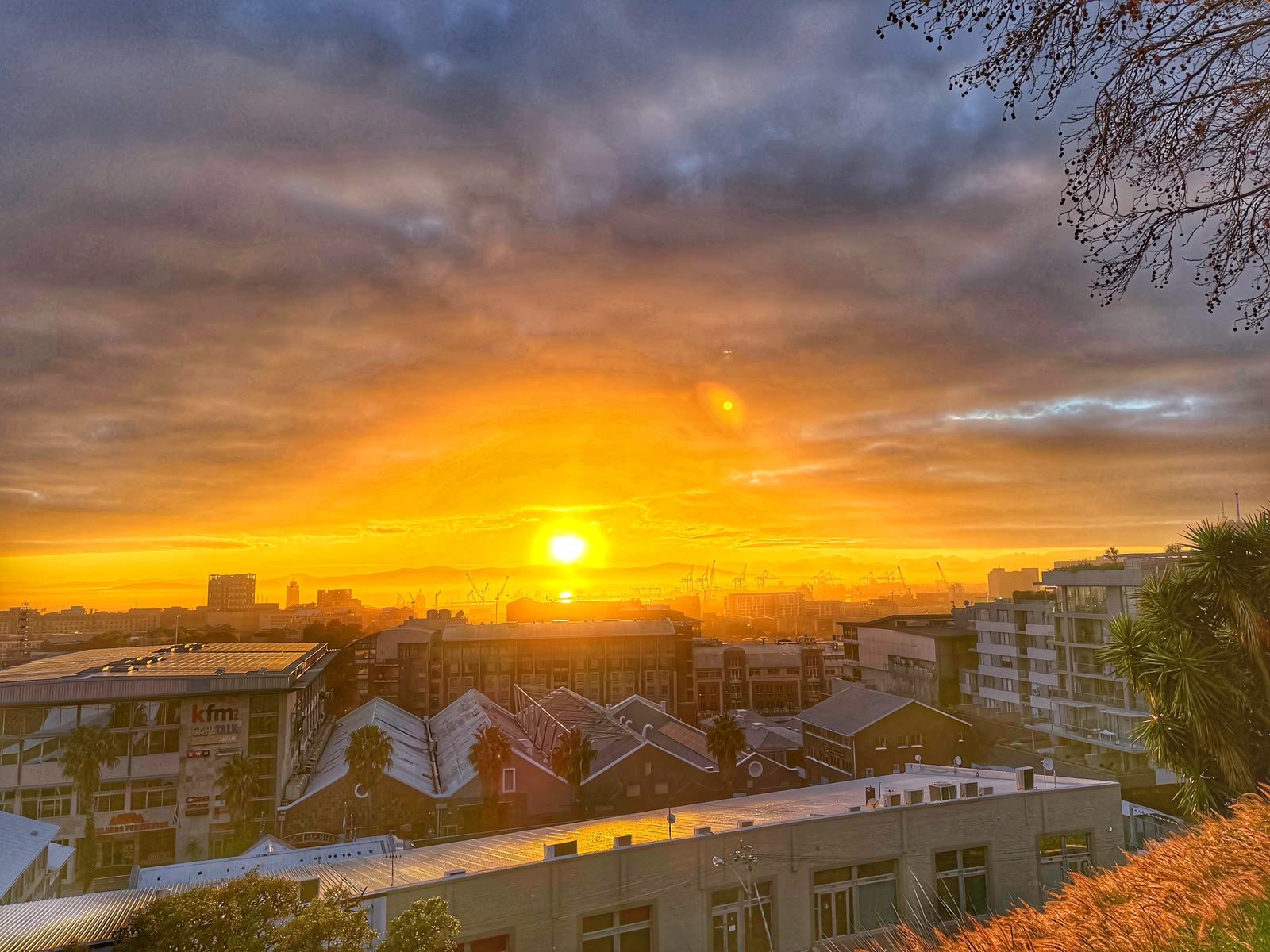
The sun rising low over Table Bay harbour, its light flooding a broken cloud ceiling and reflecting off the metal rooftops of Cape Town's city bowl.

Light arrives early here

Photographs from Cape Town — the harbour before the city wakes, smoke on the mountain, and the low scrub that waits all year for a fire.

Start reading

Cape Town is a city built at the foot of something older than it, and the mountain decides what the light does.

Some mornings the bay turns copper and the cranes go black. Some afternoons a plume rises off the slopes and half the city stands in the street watching it. These are photographs of both, and of a few places a long way from the Cape.

Cape Town, before anyone is up

Table Bay faces roughly north-west, so the sun comes up behind the harbour and lays a road of light straight across the water towards you.

First light, Table Bay

33.92° S · 18.42° E

The birds get there before the cranes do. This is the quarter of an hour when the harbour is still a silhouette and the whole bay is one colour.

Somewhere off to the left of this frame, on Signal Hill, a pair of cannon are waiting. They have been fired at midday, every day except Sundays and public holidays, since 1806 — the oldest guns still in daily use anywhere in the world. They were cast in London in 1794 and shipped to the Cape a year later, and they are still set by the observatory. If you are in the city bowl at noon and you flinch, everyone knows you are new.

Rooftops, cables, cranes — the city bowl at dawn
The same sunrise, a few minutes on

Smoke on the mountain

33.96° S · 18.41° E

Cape Town has always told stories about smoke up there. The oldest one says a retired pirate called Van Hunks used to climb the slopes to smoke his pipe, met a stranger who challenged him to a contest, and out-smoked him for days on end — until the stranger turned out to be the Devil, took offence at losing, and vanished in a flash of lightning. The cloud they left behind is the flat white sheet that pours over the summit on a south-easterly. Capetonians call it the tablecloth.

The real explanation is duller and just as good: moist Atlantic air is shoved up the mountain's flank, condenses at the top, and evaporates again as it spills down the warm side. The cloud looks like it is falling and never lands.

This plume is not the tablecloth. This is the other thing that happens on these slopes.

From the other side of the bowl, the same afternoon
Fynbos, and a summit that has given up on the day

The scrub that wants to burn

This low, wiry, flowering scrub is fynbos — Afrikaans for fine bush — and it is the reason a mountain in the middle of a city is a World Heritage Site. Table Mountain National Park holds around 1,470 plant species in roughly 57 square kilometres. The whole of Britain, some four thousand times larger, has about 1,492. Many of these species grow nowhere else on earth, and a good number grow nowhere else but one specific ridge.

Fynbos also needs fire. Seeds sit in the soil for years waiting for heat and smoke to tell them it is safe to come up. Which makes a burning mountain a more complicated photograph than it looks: bad news for the houses at the bottom, and the thing the plants have been waiting for.

If you want to see the same flora without the drama, Kirstenbosch is on the mountain's eastern foot — founded in 1913 on land Cecil John Rhodes left to the nation, and the first botanical garden in the world devoted to a single country's indigenous plants. Its curved steel walkway through the tree canopy, nicknamed the Boomslang after the snake, opened in May 2014. The avenue of camphor trees near the entrance was planted in 1898 and is still standing.

Things worth knowing before you point a camera at this place

And then, somewhere much warmer

A second archive from the same camera: thatched roofs, a lagoon that goes copper at six, and a storm that took the whole horizon. Jan Jaap to confirm the places — so for now these are filed by hour and by weather rather than by name.

Six o'clock, and the sky does the work

Everything in this frame is waiting for the same thirty seconds. The palms go flat black, the water holds the last of the blue, and the cloud on the left turns into something with a texture you could climb.

Storm light — the sun found a gap under the weather
Uplights turning the shallows green

Blue hour on the sand

The one moment when the string lights and the sky are the same brightness. Ten minutes later the sky loses and the whole beach becomes a lamp.

About Jan Jaap

Jan Jaap Heilbron spends part of his week making other people look good. At Voetzorgplus he handles the technical side of the online clinical lessons — sound, picture, and the virtual waiting room where everyone gathers before class begins. Nobody notices that work when it is done well, which is more or less the point of it.

The habit travels. What to leave in the frame and what to cut, where the light is coming from, when to wait one more minute — the attention he gives a broadcast is the attention he gives a harbour at half past five in the morning. These photographs are what happens when he turns it on the world instead of on a lesson.

Back to the beginning